JL

John LoschnigSenior Solution Architect – AI, Automation & Digital Transformation

I translate complex technology into clear decisions.

Twenty years between customers, enterprise systems and, today, production AI: agentic workflows, LLM reasoning, guarded function calling. Honest advice. The best solution rather than the easy one.

Open to AI architecture roles · Germany & remote EU · permanent EU work authorization

Write to me

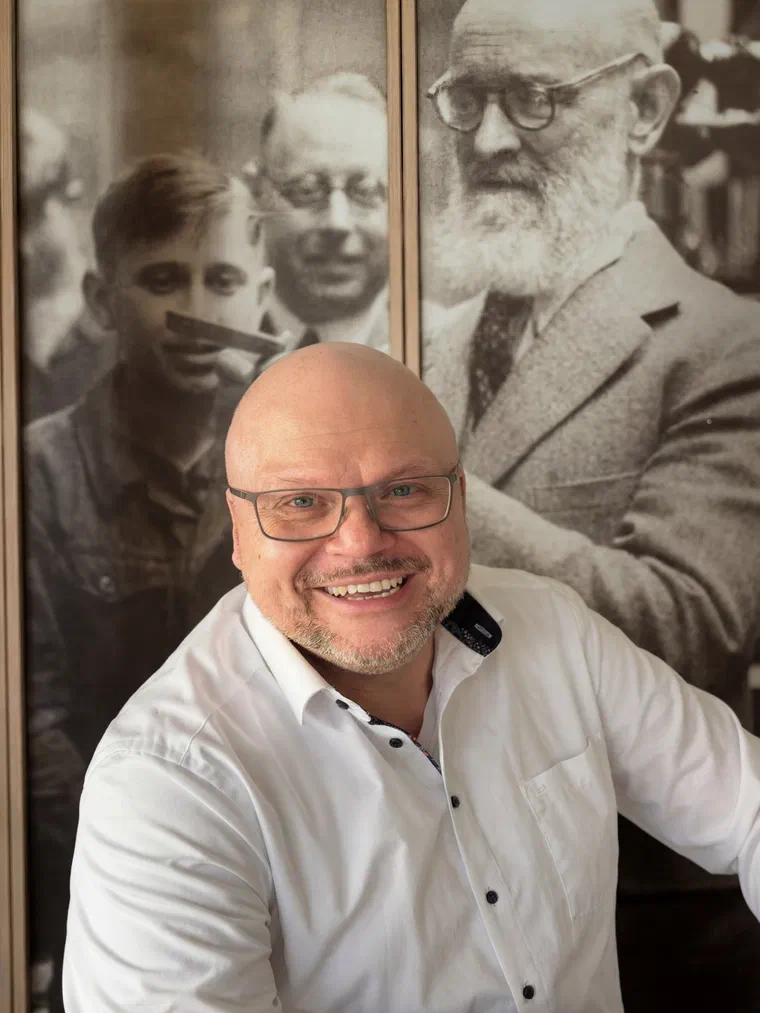
John Loschnig, smiling, in a white shirt, in front of a large sepia photograph of Robert Bosch
Fig. 1 – In front of a portrait of Robert Bosch, my role model. His principle in one sentence: better to lose money than to lose trust.
20+
years in enterprise IT
11+
years vendor-side pre-sales: HP, WSP, Clientfocus
8
years architecture at Robert Bosch
4
languages my research model understands

Now

Putting AI into a production network platform.

At Robert Bosch I architect one of the two core components of Network Enterprise Orchestration (NEO), the platform that manages network infrastructure across the organization. Since 2022 I have been designing AI-driven and machine learning applications that optimize inefficient, time-consuming processes.

Resolution engine, simplified
  1. 1failed transaction
  2. 2normalized logs
  3. 3LLM reasoning
  4. 4whitelisted functions only
  5. 5not successful → people informed via channel (Teams / Outlook)
  6. close → inform
  7. self-healing feedback: retry with a whitelisted fix

The interesting part is not the model. It is the fence around it: which functions it may call, what it must explain, and when a human decides.

AI adoption

I design AI use cases and present them to senior architects and tribe leads. I co-initiated an AI use-case discovery barcamp as part of the Bosch Digital AI initiative and am a member of the company-wide AI network.

Service API architect

Responsible for durable APIs built on established engineering practice – the unglamorous foundation every agent eventually depends on.

Research

Evolution EngineA personality you can embed.

How can sensor signals – a user’s voice, facial expression, text – make a model’s artificial “emotions” visible and feed them back to the language model within milliseconds, so that it can respond to people better?

This question has occupied me for a long time. My answer: an artificial individual grows up in a simulated world. A life path shaped by chance – parents, care, friends, colors, music, touch and temperament – forms it. What remains is a small personal model that analyzes text fragments in German, English, Russian and Ukrainian within milliseconds and reacts to them. It also recognizes feedback and repetition, which strengthen stimuli and tendencies.

Fig. 2 – Luna, one simulated individual, as 42 numbers. Ink: what is fixed in her – personality, stability, attachment, needs at rest. Pencil: what changes with every sentence she hears – reaction, mood, coping, stress. Archetype: gentle soul · securely attached · copes well
Fig. 3 – Brain Monitor: eight channels of a simulated individual over time. Channels 0 … 1, right = now. Vertical lines mark impulses – sentences the individual hears. The fine jitter shows arousal; it is display, not measurement.

The model

  1. 42outputs

    Emotion model

    Reaction, emotional state, personality, eight needs, coping, stress. Exported to ONNX, embeddable in Python or Node.js.

Built like a product, not a demo

Same seed, same life.
Every individual is reproducible: the same seed always produces the same life and the same personality.
Every export checks itself.
Each ONNX export is verified against the reference runtime and reports its own deviation.
Guardrails as data.
Each individual carries warning, caution and positive flags, so a host app can refuse to load an individual before it ever speaks.
Runs offline.
Quantized models, Python and Node runtimes, a desktop app for Windows, Linux and macOS. No cloud required.

Honest footnote: the personality formulas are heuristic assumptions, not a validated psychological model. I say that on page one of the documentation, too.

Capabilities

What I bring – and what it means in practice.

Twelve things I do, explained the way I would explain them in a first meeting. Scroll, or jump straight to a topic.

Architecture

Rapid prototyping

Something to click on by Friday.

A working prototype ends discussions that slides cannot. I build quickly to make decisions possible – and say clearly which parts are prototype and which are ready for production.

In practiceAt Bosch, a self-developed harness application for prototyping agent-to-agent communication without writing a single line of code – with export to MCP or n8n workflow artifacts. Before that: proofs of concept at R+V, Clientfocus and Hewlett-Packard.

  • Proof of concept
  • Iteration
  • Demos
Architecture

Solution & enterprise architecture

Systems that still make sense in five years.

Integration, service APIs, platforms that many teams depend on. Good architecture is mostly about saying no early and writing down why.

In practiceArchitect of one of the two core components of NEO at Bosch; ITSM transformations for KfW, Audi, Volkswagen, Clariant, T-Systems and DB Systel – business solutions on premises and air-gapped, plus interface integrations.

  • Integration
  • Service APIs
  • ITSM
With people

Pre-sales & discovery

Understanding the problem before selling a solution.

Workshops, stakeholder conversations, technical demos. I translate between the people who need something and the people who build it – honestly, including when the answer is “you don’t need AI for this”.

In practiceAt Bosch: internal trainings. Before that: 11+ years of vendor-side pre-sales across EMEA at Clientfocus, WSP and Hewlett-Packard.

  • Workshops
  • Stakeholders
  • Demos
With people

AI trainings & enablement

Teams that understand AI make better decisions about it.

I explain AI without hype and without fear – for engineers, managers and everyone in between, in German and English.

In practiceAt Bosch Digital: several AI trainings and presentations; co-initiated an AI use-case barcamp. Earlier at Hewlett-Packard: training programs for service management teams across Europe, and live product presentations at the HP Software summits in Barcelona and Hamburg.

  • Training
  • Barcamps
  • Knowledge transfer
AI, ML & data

Agentic workflows

Language models that work in steps – plan, act, check – instead of just answering.

An agentic workflow lets a model choose its next step: call a tool, read the result, decide again. That freedom is powerful and expensive, so I design where autonomy pays off and where a fixed process is the safer, cheaper answer.

My rule: as much workflow as possible, as much agent as necessary.

In practiceBosch agent harness: workflow design based on JSON, built with FastAPI, Python and Node.js. Bosch NEO: an AI resolution engine that analyzes failed transactions and proposes the next action.

  • Planning
  • Tool use
  • Human in the loop
AI, ML & data

Agent-to-agent communication

Specialized agents that hand work to each other – through contracts, not chatter.

When several agents cooperate, the interfaces between them matter more than any single prompt: who may ask whom, what is passed along, how a failure becomes visible. I treat agent-to-agent (A2A) messages like service APIs – typed, versioned, logged.

In practiceBuilds on years as Service API architect at Bosch: infrastructure, RHEL operations, incident, service request and change management, development and deployment.

  • A2A
  • Contracts
  • Observability
AI, ML & data

MCP architecture & function calling

Giving models access to real systems without handing over the keys.

The Model Context Protocol (MCP) standardizes how models reach tools and data. I design MCP servers and function sets that are small, well described and whitelisted – so a model can only do what the business has approved, and every call can be traced.

In practiceFunction whitelisting in the Bosch resolution engine.

  • MCP
  • Function calling
  • Least privilege
AI, ML & data

Agent harness development & guidelines

The frame around the model: loop, context, tools, permissions, logging, stop rules.

The model thinks; the harness decides what actually happens. I build harnesses and write the guidelines teams need to build their own consistently – so ten agents in a company behave like one architecture, not ten experiments.

In practiceAt Bosch: a self-developed harness application – agent-to-agent prototypes without code, exported as MCP or n8n workflow artifacts.

  • Harness
  • Guidelines
  • Reference architecture
AI, ML & data

Guardrails & safe functions

Deciding in advance what an AI may never do.

A model can be convincing and wrong at the same time. Guardrails make that harmless: whitelisted functions, validated inputs and outputs, human approval for anything irreversible, and an audit trail that explains afterwards why something happened.

A blind spot I take seriously: leaking through reasoning. A guardrail blocks the answer – the user never sees it. But the model’s reasoning may still contain exactly that answer. The reasoning ends up in a log file, another agent reads the log, processes the content and passes it on. Current checks mostly inspect the final answer; reasoning traces and logs are covered only partly or not at all.

That is why I treat reasoning and logs as outputs, too: the same checks, redaction before anything is written, and no agent reads another agent’s raw reasoning.

In practiceWhitelisted functions and Teams / Outlook alerting at Bosch; warning flags in the Evolution Engine.

  • Safety
  • Validation
  • Audit trail
  • Leakage
AI, ML & data

Data science & machine learning

Understanding the data first – choosing the model second.

Before any model there is data: cleaning, normalizing, finding the signal. For large log volumes I build the foundation underneath: ClickHouse as the analytical database, log vaults for secure long-term storage, and a Parquet transformer that turns raw log files into columnar, compressed files that are fast to query.

On that basis I use classical machine learning where it beats a language model, and neural networks where it does not.

In practiceNeural personality models trained per individual in the Evolution Engine; normalized log analysis at Bosch.

  • ClickHouse
  • Parquet
  • Log vaults
  • Feature engineering
  • Neural networks
AI, ML & data

Custom RAG

Answers grounded in your own documents – with sources.

Retrieval-augmented generation lets a model cite your knowledge instead of guessing. I build the retrieval myself – chunking, embeddings, ranking – so it is always clear why an answer appeared and where it came from.

In practiceOwn implementation, not a black-box product.

  • Retrieval
  • Embeddings
  • Citations
AI, ML & data

Local & air-gapped AI

Local or not local – that is the question.

How do you protect company data – and does it make sense to own locally operated systems? After all, a single RTX 6000 card costs around €17,798 (October 2026).

My answer is a clear yes for mid-sized companies that want or need to keep their intellectual property to themselves. But be aware: the basic prerequisite is an analysis of the data. A good solution combines AI with deterministic tools and a very well-designed MCP landscape that connects the models cleanly to the systems. Part of it is GPU and VRAM management that distributes the load sensibly, plus scheduled nightly jobs whose results can be used the next day without any GPU or VRAM.

Technically and at the architecture level, I look after models across their whole lifecycle – plan, build, run: from LoRA fine-tuning to operation on GPU Docker stacks, fully offline if required.

In practiceIn the enterprise, a wide range of models (GLM, Mistral, Claude by Anthropic, GPT, Gemini) are connected through a security layer and used in workflows built with n8n or OpenText. In my own projects, the Evolution Engine runs completely offline, and my content pipeline translates with a local model.
  • LoRA
  • ONNX
  • Plan, Build, Run

Hands onPython · FastAPI · Docker · Linux RHEL · REST · Git · Bash · JavaScript · Oracle DB

Principles

How I work

“I would rather lose money than lose trust.”

— Robert BoschThe best design principle for AI I know.

How I work

  1. Never lose your curiosity.
  2. Look beyond your own plate.
  3. If it can't be explained simply, it isn't finished yet.

Germans say "über den Tellerrand schauen". Tastier than thinking outside the box.

Career

Twenty years, one through-line: making systems understandable.

  1. 2018 – today

    Solutions Architect, Network Enterprise Orchestration

    Robert Bosch GmbH, Stuttgart

    Core platform architecture, service APIs and, since 2022, AI and machine learning applications that automate time-consuming processes. Driving AI adoption across network management.

  2. 2016 – 2017

    Systems Engineer

    R+V Versicherung, Wiesbaden

    Rollout management for web portals; led a configuration-management proof of concept from market analysis to validated prototype.

  3. 2012 – 2016

    Lead Solution Architect

    Clientfocus GmbH, Frankfurt

    Pre-sales and architecture for ITSM transformations – KfW Bank (CMDB transformation), Audi (requirements for ITSM transformation). Led delivery teams.

  4. 2009 – 2012

    Solution Architect

    WSP-Consulting GmbH

    Demanding ITSM projects in Germany and abroad; speaker and workshop facilitator at industry conferences.

  5. 2005 – 2009

    Information Systems Architect

    Hewlett-Packard GmbH, Böblingen

    Pre-sales across EMEA: workshops, proofs of concept, product strategy with engineering.HP Professional Services Innovation Award, 2007

  6. 2001 – 2005

    Software Developer · Quality Manager

    Fresenius Medical Care · CALCUCARE

    ITIL tooling, ISO 9001 / ISO 13485 certification, a three-month build in the USA.

Clients along the wayKfW · DB Systel · DHL · Robert Bosch · Audi · Volkswagen · Clariant · T-Systems

Recent learningNeural Networks and Deep Learning (DeepLearning.AI, 2026) · Generative AI (IBM, 2026) · Certified IT Specialist, Systems Integration (IHK, 2024) · PSM I · ITIL v3

Author of Application Development 2.0 (epubli, 2012, 260 pages).

Learning

Learn with me.

Short explanations of the ideas I work with every day.

Video introduction – coming soon.

Until then: tutorials and talks on my YouTube channel.

Open the channel →

Blog

From the blog.

Notes on AI, architecture and responsibility – written by me, published in German, English and Ukrainian.

  1. Silent Danger in the Background: Why Fallbacks Can Cascade Test PhasesIt’s not a trap, it’s a feature… wait!
  2. Paper Office improves Office manipulation via AI agentsNew Python packages enable AI agents to edit Word, PowerPoint, and Excel files with greater precision.
  3. Optimal Prompt Ordering Using the Logic of Maya the BeeThe arrangement of information within a prompt significantly impacts the accuracy of large language models.

All posts on speedbrain.ai

Contact

Planning an AI system that people need to trust?

Let's talk about it – architecture, trade-offs, and what not to build. I reply personally, usually within five working days.

Save contact (vCard) Scan with your phone camera to save my contact – name, email, phone, website and LinkedIn.

Karlsdorf-Neuthard, near Karlsruhe · Canadian citizen · permanent EU work authorization